
The dress code at Duomo Milan is a strict entry requirement mandating that all visitors cover their shoulders and knees while inside the cathedral. Security personnel enforce these regulations by denying access to individuals wearing sleeveless tops, short shorts, mini-skirts, or hats. Compliance is compulsory for men, women, and children to ensure admission.
Milan’s Cathedral is an active place of worship, and that means playing by certain rules.
Please note that if you are denied access for not complying with the dress code, there will be no refunds, without exception.
The dress code at Milan’s Duomo is strictly enforced, especially for the Cathedral interior. Security personnel stand at the entrance specifically to check that visitors are dressed modestly, and they won’t hesitate to turn you away if you’re not.
The core rule is simple: shoulders and knees must be covered at all times for both men and women inside the Cathedral. That means no sleeveless tops, no shorts above the knee, and no beachwear.
Rules aren’t quite as strict on the rooftop terraces and in the museum areas. Many visitors say “for terraces anything goes,” meaning you can dress more casually if you’re only visiting the rooftop. But here’s the catch: if your ticket includes the Cathedral (and most do), you need to dress for the stricter code from the start. You can’t just change outfits halfway through your visit.
In this infographic, you can see the different types of clothing that are permitted or not permitted:
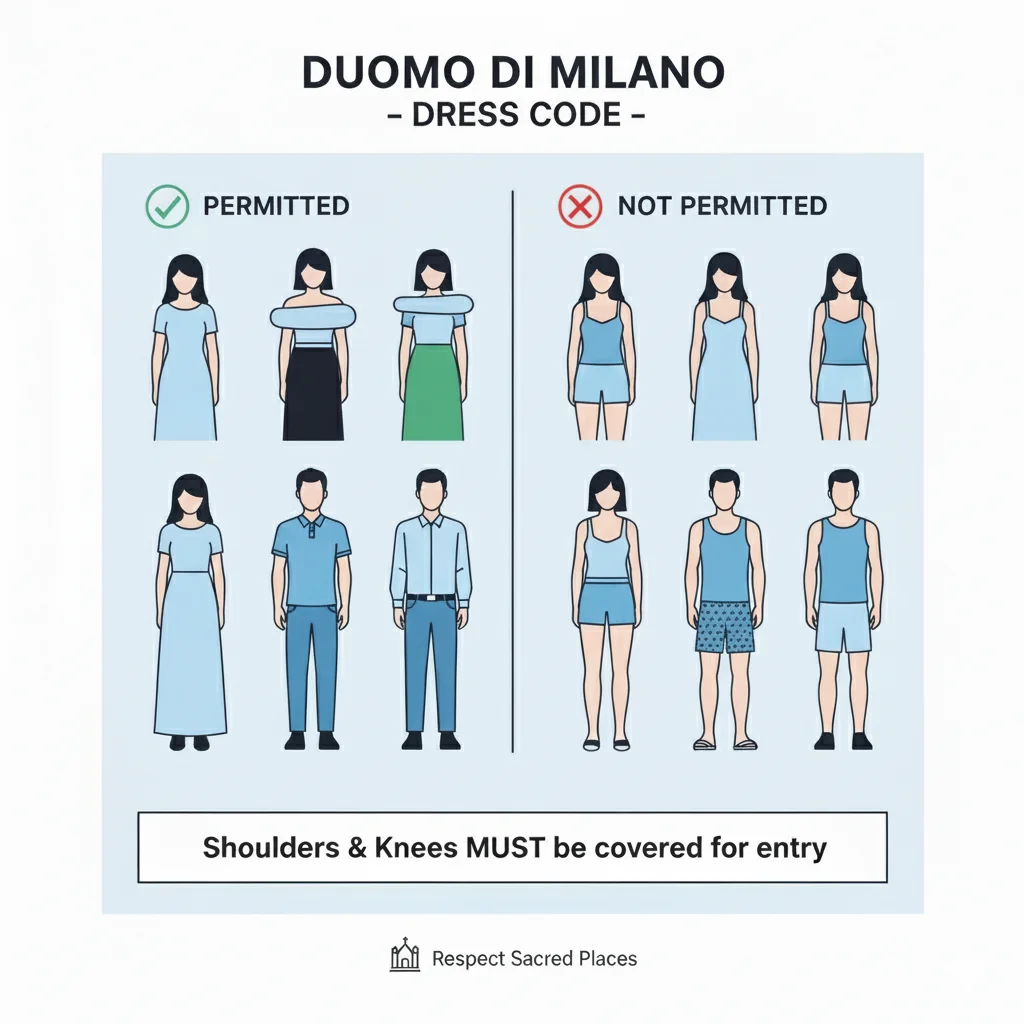
The Duomo’s policy explicitly bans certain clothing items due to their lack of modesty. In general, avoid anything revealing, skimpy, or overly casual if you plan to visit the Cathedral. Think of it this way: if you wouldn’t wear it to meet your partner’s conservative grandparents, probably don’t wear it to the Duomo.
Women need to keep both shoulders and knees covered at all times inside the Cathedral. Your top should have sleeves (at least cap sleeves that cover the shoulder). Tube tops, strappy tank tops, or sleeveless outfits are a no-go unless you add a shawl or cardigan over them.
Low-cut or bare-back tops won’t work either. Avoid plunging necklines or backless dresses that show too much skin. The goal is modesty, not prudishness, but you get the idea.
For bottoms, short skirts or shorts above the knee are prohibited. Your skirt or dress should extend past your knees, or you can wear long trousers, capri pants, or midi-length skirts. Mini-skirts and mini-dresses simply won’t pass security. If you’re wearing leggings or tights, make sure they’re opaque and paired with a longer top or skirt that covers you to the knee.
Sheer or transparent fabrics should be avoided too. If your outfit can be seen through (think lace blouse with nothing underneath or very thin white pants), that violates the modesty rule. And obviously, any clothing with offensive graphics or slogans isn’t acceptable in a holy site.
As for footwear, while heels are technically permitted, extremely high stiletto heels might be unsafe on those uneven marble floors and steep staircases. Flip-flops or beach sandals are officially not allowed (aside from respect, it’s a safety issue on stairs). In practice, many women wear nice flat sandals without issue, but to be absolutely safe, closed-toe flats or walking shoes are your best bet.
One more thing: remove hats or caps inside the church. This applies to everyone, but especially women who might wear fashion hats. Head coverings for religious reasons are obviously fine.
| Forbidden for Women | Details/Examples |
|---|---|
| Bare shoulders | No tank tops, strapless tops, halter necks, or spaghetti straps |
| Short skirts/shorts | Hemlines must go below the knee (no miniskirts or short shorts) |
| Low-cut or backless tops | Avoid deep V-necks, plunging necklines, or open-back dresses |
| See-through clothing | Sheer blouses, transparent lace, or mesh outfits are not allowed |
| Offensive graphics | No profanity, crude images, or disrespectful slogans on clothes |
| Hats inside the Cathedral | Fashion hats/caps must be removed (religious headscarves are okay) |
| Flip-flops/beach footwear | No rubber flip-flops or ultra-casual sandals (unsafe and too informal) |
Men face the same standards of modesty. No bare shoulders, no bare knees inside the Cathedral. This means wearing long pants (trousers or jeans) or at least shorts that fall well below the knee. Standard shorts that leave your knees exposed won’t get you through the door.
If it’s hot and you prefer shorts, choose longer Bermuda-style shorts that genuinely cover the knee. Many guards will treat those like pants and wave you through. But short shorts or cut-offs? Definitely forbidden. Some travelers report success with knee-length shorts, while others have watched men get turned away for shorts deemed too short. When in doubt, go longer.
What about ripped jeans? While not explicitly banned, extremely torn jeans or dirty gym clothes might cause issues with the strictest guards since they suggest overly casual attire.
| Forbidden for Men | Details/Examples |
|---|---|
| Bare shoulders | No tank tops, sleeveless jerseys, or vests. Wear shirts with sleeves. |
| Shorts above the knee | No short shorts. Knees must be covered (opt for long pants or knee-length shorts). |
| Offensive images/text | T-shirts with vulgar language, hate symbols, or rude graphics are not allowed. |
| Hats or caps (inside) | Remove any non-religious headgear upon entry. |
| Extreme casual attire | Avoid swim trunks, sleeveless undershirts, or very ripped clothing (seen as disrespectful). |
| Flip-flops | Not officially permitted. Men should wear proper shoes or sandals, not beach flip-flops. |
Yes, children are expected to follow the same general dress guidelines as adults. This means trying to have your kids’ shoulders and knees covered, especially for older children who are school age.
In practice, enforcement for very young children (toddlers and babies) tends to be more lenient. No one’s likely to turn away a 3-year-old in shorts. But for school-age kids and teenagers, you should definitely ensure they dress modestly since staff will apply the rules if there’s an obvious violation.
The Duomo Milan dress code mandates that men cover their knees to gain entry. Security personnel enforce the “no-knees-showing” rule equally for male and female visitors. Guards frequently deny access to men wearing shorts that end above the knee. So, male visitors must wear trousers, jeans, or long shorts that extend clearly below the kneecap to comply with Cathedral regulations.
Veneranda Fabbrica del Duomo di Milano generally permits standard walking sandals within the Cathedral. Official guidelines discourage rubber beach flip-flops or open-toe shoes primarily for safety reasons. Security staff rarely refuse entry based on substantial sandals. Visitors should prioritize footwear with grip. The Duomo features smooth marble floors and Rooftop stairs that become slippery, creating a hazard for unstable shoes.
Normal sandals are generally tolerated. Travel forum regulars note that “no worries about sandals… I’ve never seen a single report from a visitor turned away for wearing those.”
Duomo’s Rooftop requires the same modest attire as the Cathedral interior. Visitors possessing a combined ticket for both the church and the Terraces must adhere to strict modesty rules regarding covered shoulders and knees. Athletic wear or gym clothes usually fail to meet these standards. Safety remains a priority on the Terraces. The staircases are narrow, steep, and constructed of marble, requiring stable, non-slip footwear rather than aesthetic beach shoes.
No, don’t even think about it. The dress code isn’t a checkbox you tick at the entrance and then forget about. It’s about respecting the sacred space for the entire duration of your visit.
Milan in summer can be brutally hot. We’re talking 30°C+ (85°F+) in July and August. The thought of covering up might sound uncomfortable, but you can absolutely beat the heat while meeting the dress code.
Winter clothing naturally tends to meet the Duomo’s dress code since you’ll likely be wearing long pants and jackets anyway.
Milan’s Duomo isn’t the only place in the city (or Italy) where you should be mindful of how you dress. As a traveler, it’s useful to know that most religious sites have similar rules.
Here’s a quick rundown of where else to keep that shawl handy:

TICKETS
When you visit the Duomo in Milan, this ticket gives you access to important attraction. The ticket is valid for three days from the date you…
TRAVELER INFORMATION
The main cathedral and the archaeological area are open every day from 9:00 AM to 6:00 PM. Duomo Milan’s opening hours are the same…
DUOMO MILAN INFORMATION
The Duomo di Milano also known as the Milan Cathedral is an amazing architectural wonder. It is one of the largest Gothic cathedrals…


